 thrive and awaken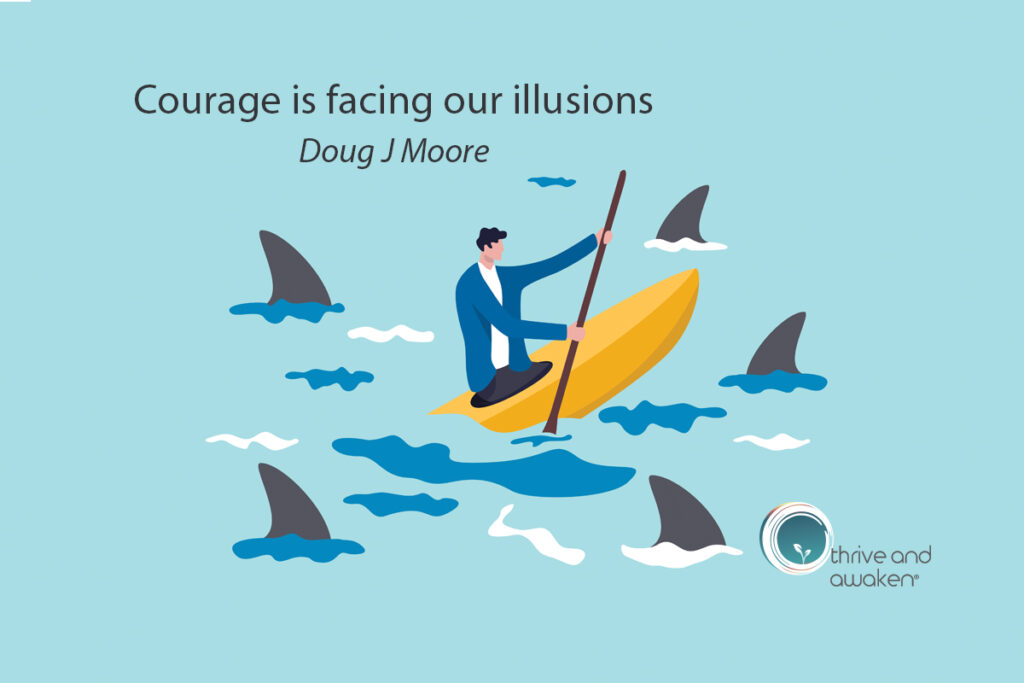
Thrive and Awaken® Tip
Much of what we take as solid, separate, and fully under our control is shaped by perception, conditioning, and habit. Physics and psychology both point to a deeper reality where everything is more fluid and interconnected than it appears. It takes courage to question what we assume is real and to live from a deeper understanding rather than from appearances alone.
We live within a set of powerful illusions, and we usually don’t question them. One of the most familiar is the sense that everything is solid. You feel solid. Your home feels solid. The world appears solid. Yet physics shows us something quite different. What we call matter is mostly space, a dynamic field of energy. This is why signals like WiFi can move freely through walls and rooms. What feels fixed is far more fluid than it appears.
Another common illusion is the belief that we fully choose our thoughts. While choice exists, much of our thinking and emotional reacting is conditioned. Our perceptions are shaped by early experiences, personality style, biology, and culture. We take in only a narrow slice of reality and then interpret it through filters we did not consciously choose. If you had grown up in a different family or culture, with a different temperament, your beliefs about the world would be very different.
Perhaps the most deeply held illusion is the belief that we are separate from one another. Modern physics helps us understand our connection within the Universe. The elements that make up your body were formed in exploding stars. The same energetic field that expresses itself as you expresses itself as everything and everyone. Research into quantum entanglement shows that particles once connected remain correlated across vast distances, suggesting a reality that is fundamentally interconnected rather than fragmented.
There are many other examples, but these illustrate how easily we live guided by appearances rather than deeper reality. It takes courage to examine these illusions, not to discard everyday functioning, but to see beyond it. Cognitive scientist Donald Hoffman suggests our perceptions are like the instruments on a cockpit dashboard. They help us navigate, but they are not reality itself.
Courage is the willingness to look beyond the dashboard and question what we assume is solid, separate, and under our control. Doing so brings an understanding of the vastness of reality and the mystery of existence and connection.